Previous post on the Ainu: Land of the She-Bear Women
Umeko Ando – Futare chui. Album : Ihunke ( 2001 )
The traditional instruments of Ainu Music are the Kontori (or Kontari) and the Mukkari
The Kontori: The five strings of the Kontori are not fretted nor blocked in any way, but played open, like if you played a guitar using only the right hand.
The Mukkuri is only played by women, The music is a style only played by women, the Mukkiri jaw’s harp with humming, singing and harmonics effects.
Oki Kano is the founder of the Oki Dub Ainu Band, with Dub and Psychelic Rock influences but remains rooted in Ainu Music, his instrument is the Kontori.
A modern Ainu song by Oki Kano
The Psych/Dub side of Oki:
East of Kunashiri by Oki Dub Ainu Band
To go deeper, check out Ainu World on YouTube.
THE YUKAR
Yukar are the traditional sung epics of the Ainu. An unusual feature of Ainu epics is that they are told in the first person, the storyteller impersonating a famous hero (or sometimes an anonymous one), an animal, a river or a mountain. Yukar are usually 5000 to 10 000 lines.
KUTUNE SHIRKA
Close to a harbor on the shore.
A pleasant breeze blew on me and the face of the sea
Was wrinkled like a reed-mat.
And on it the sea-birds
Tucking their heads under their tails,
Bobbing up their heads
Called to one another
Now it happened at this time
Some stray talk reached me
By roundabout ways
That at the mouth of the Ishkar
A golden sea-otter
Was diving for its food,
And that the Man of Ishkar
Had sent news flying,
To far off villages.
News had been brought,
And this was what it said:
To whoever can dive into the sea
And bring back the Golden Otter
I will give my sister,
And all the treasure that is mine
The Hero then manage to steal the Golden Otter. The people of Iskhar go to war to get the Otter back. There’ s many battles, a great banquet, a love story between the hero and the daughter of a Iskhar chieftain, and more adventures before the story ends by a puzzling interrogation.
“A godlike hero
Has meted punishment
We have no more to fear
Let us go back to our home”.
But I thought to myself,
Where is this village of Peshutun
That the girl said she came from?
If without destroying it
I were not to go back home,
Would it not be said I was afraid?
That was what I thought to myself.
KUTUNE SHIRKA, THE AINU EPIC translated by Arthur Waley. Botteghe Oscure, Rome, 1951
This is footage from the Ainu Bear Ceremony. During the Bear Ceremony, a bear who had been adopted young and treated as a pet is sacrificed, and the meat is cooked and shared amid celebrations, songs and dancing. Note: There is nothing too gory in the video but if you want to avoid seeing the bear at all, go straight to 4:oo.
I wish I understood Rekuhkara singing better:
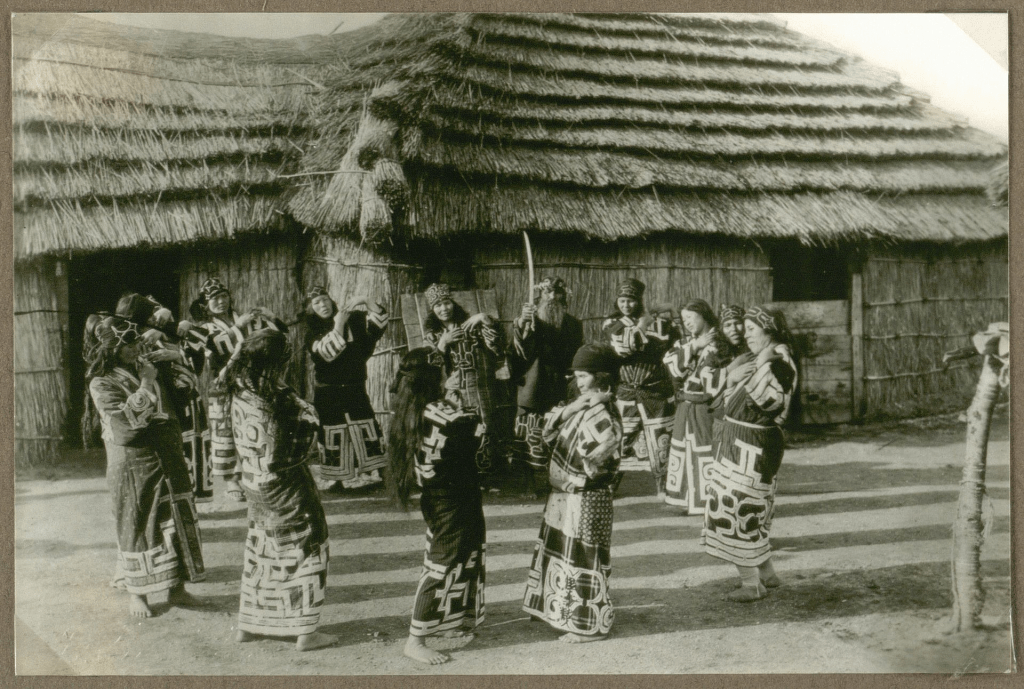
Photo By National Museum of Denmark from Denmark – Ceremonial round dance, resembles the Japanese Bon-Odori (Temple dance in which the departed are commemorated)Uploaded by palnatoke, No restrictions, https://commons.wikimedia.org/w/index.php?curid=29790662
 THE INACTIVIST
[…] the original inhabitants of Hokkaido before the Japanese. More on the Ainu by the inactivist on: Ainu Songs and Land of the She-Bear […]
LikeLike