
The Buddha Tooth Relic Temple and Museum in Singapore has spared no effort to create a fun, labyrinthic Web site in English where you can spend hours lost in Buddhist Art and Culture. A 3D panorama of the Tooth Relic Room (on the 4th floor) is itself worth the detour. I especially appreciated the details given on the iconography of Buddha Sakyamuni and of the many Boddhisatvas. The hand gestures in particular carry a lot of meaning.
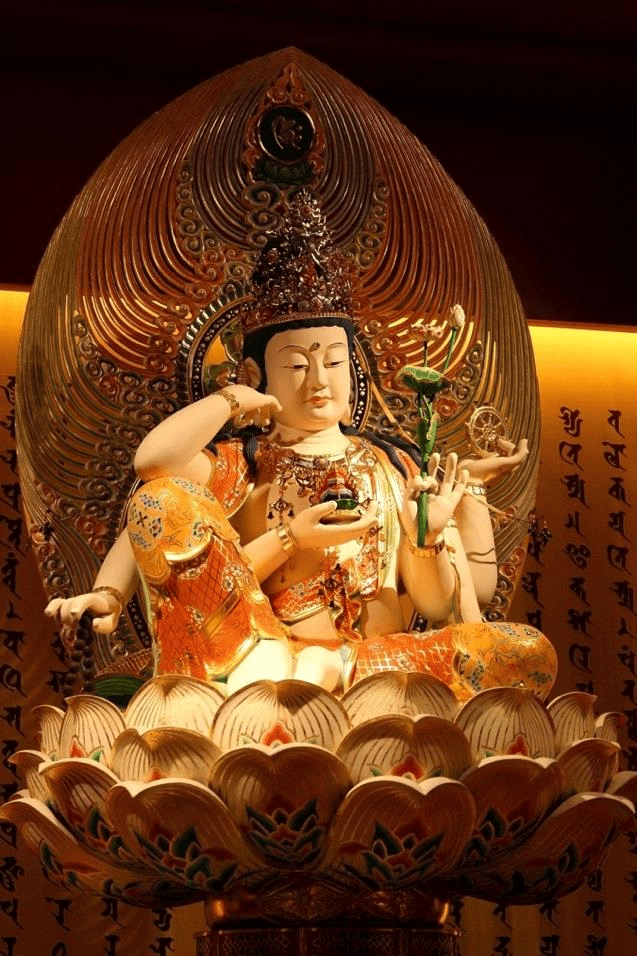
Cintāmaṇicakra, AKA चिन्तामणिचक्र, is a manifestation Avalokiteśvara, the Boddhisatva of Compassion, better known under they’re Chinese name Guanyin. Some manifestations of Avalokiteśvara are female, others are male. Cintamanicakra is male.
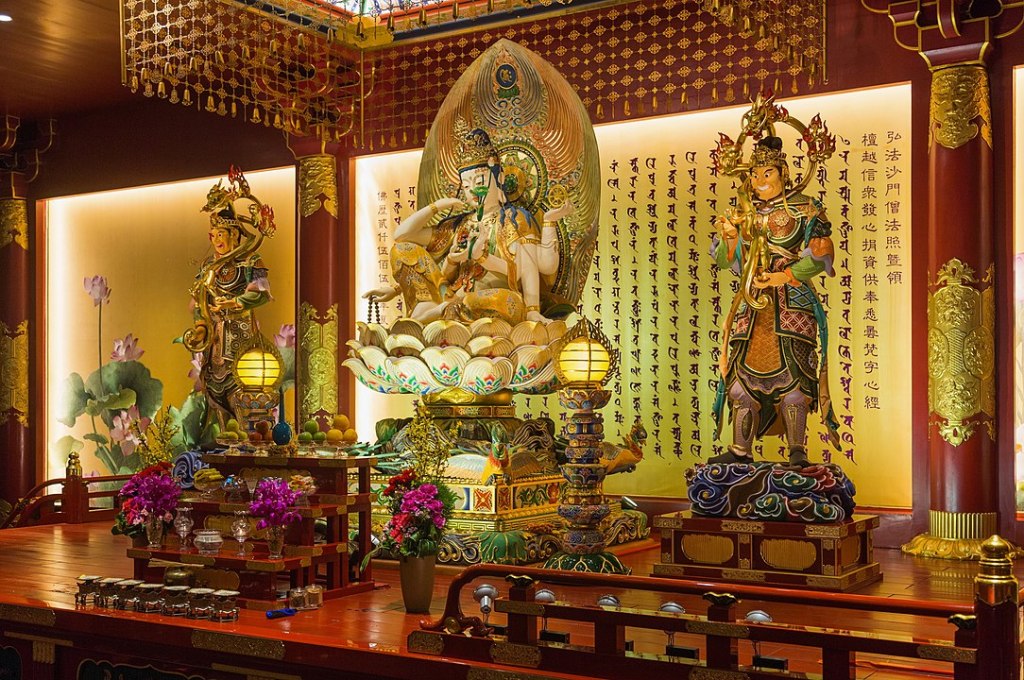
The Temple explains: “The Bodhisattva Cintamanicakra Avalokitesvara sits calmly in a typical Rajalilasana (royal ease posture), bare to the waist, atop a large Padmasana (lotus) throne floating on the sea waves, with a phoenix at each corner. The aureole is shaped like a lotus petal curved towards His head. There are colourful swirling aura and clouds radiating from His Head.”
“The image of Bodhisattva Cintamanicakra Avalokitesvara has six hands: His first right hand touches the cheek in a pensive pose, His second right hand holding a wish granting jewel (cintamani), His third right hand holding prayer beads. His first left hand pressing the Mount Meru, His second left hand holding a lotus flower and His third left hand holding a Dharma wheel. On His head is a highly decorated chignon with an elegant gilt crown denoting the royal status.”


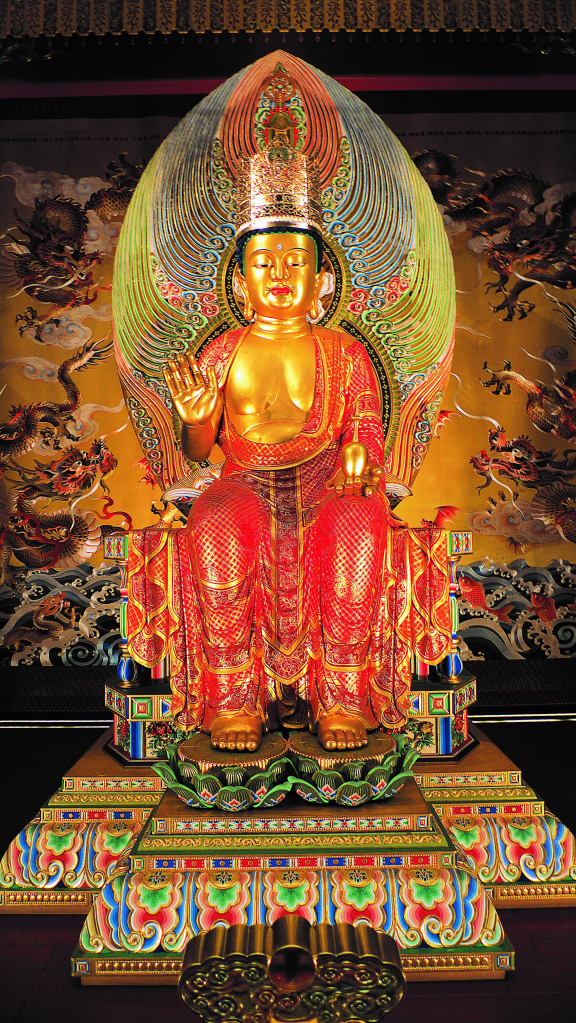
The Temple informs us that “the Buddha Maitreya sits in a typical Tang Bhadrasana (auspicious) posture, also called Pralambapadasana (European pose), with feet resting on a lotus, symbolic of royalty.”
The right hand is raised in the Abhaya mudra (protection, benevolence, peace and dispelling of fear), and the left hand, resting on the left knee, holds a golden water bottle (kundika) containing the amrita.
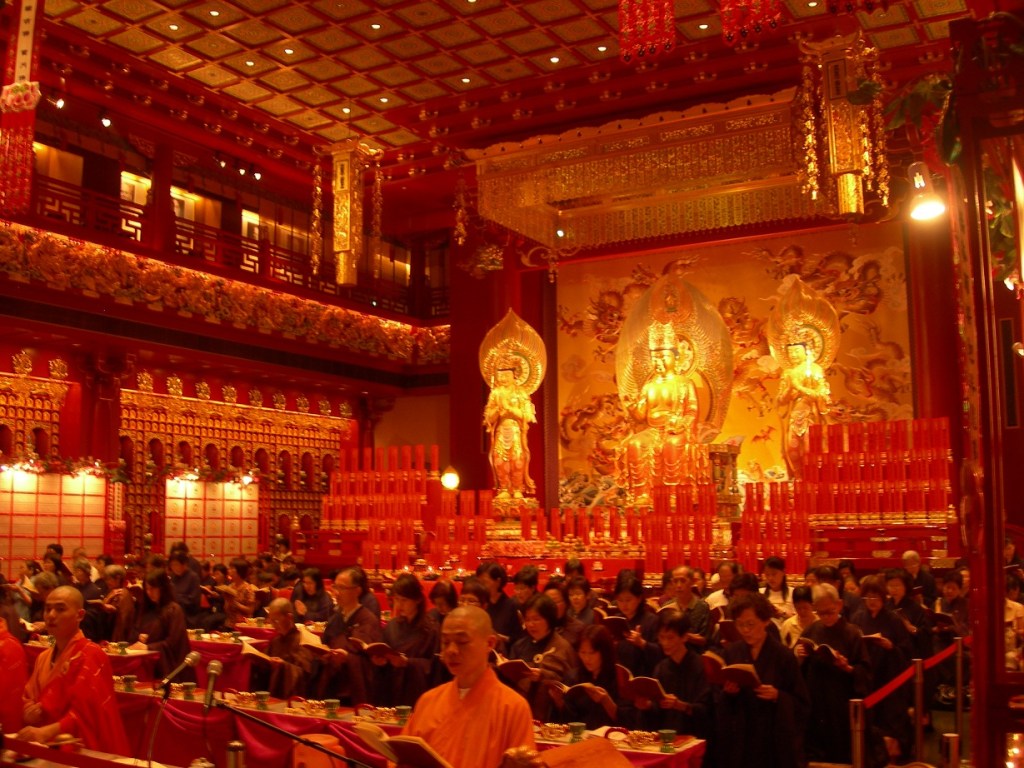
Inside the Hundred Dragons Hall, you will notice the pervading sense of calm and peacefulness; the presence of many devotees offering to Buddha Maitreya fresh Dendrobium orchids, perfumed candles and agarwood incense, whilst whispering their prayers and wishes. During Buddhist ceremonies, the Hall will be filled with the voices of numerous black-robed devotees chanting the sutras with Venerable Chao Khun Fa Zhao. A wonderful juxtaposition of sight, sound, smell and spirituality!“
Shrine to Cintamanicakra : By Photo: Marcin Konsek / Wikimedia Commons, CC BY-SA 4.0, https://commons.wikimedia.org/w/index.php?curid=54736460
Inside of the Hundred Dragon Hall, By Riction at en.wikipedia, CC BY 3.0, https://commons.wikimedia.org/w/index.php?curid=10601683
 THE INACTIVIST
[…] Another of our post on the Buddha Tooth Relic Temple at the inactivist–buddha-tooth-relic-temple-of-singapore/ […]
LikeLike
[…] cultures. Guanyin is one of the female depictions of Avalokitasvara as is Cintāmaṇicakra (see Post 1) is one of the male […]
LikeLike