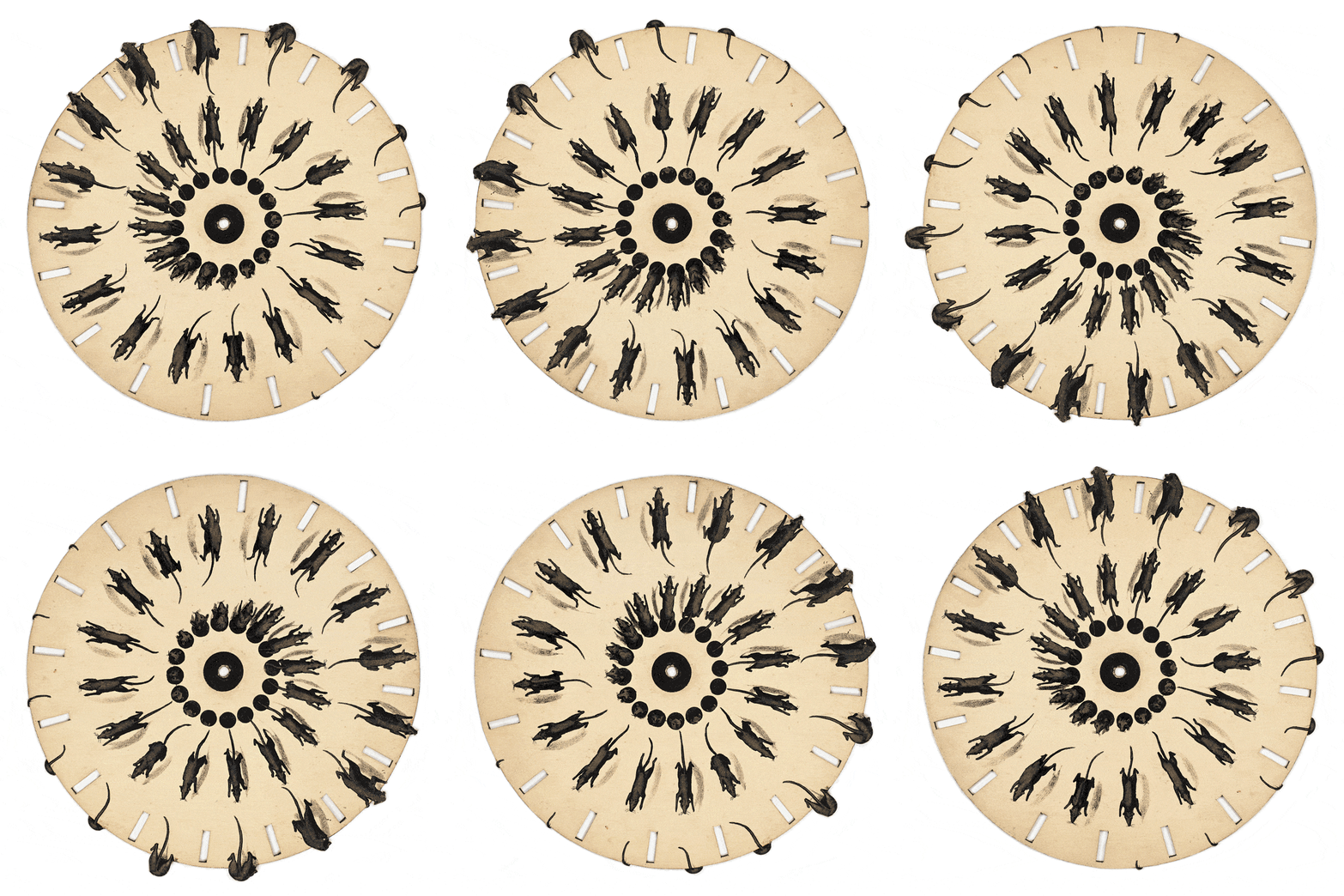
Phenakistiscope disc (16 sections, time lapse 0.10 s) – Running rats, Fantascope by Thomas Mann Baynes. Manufactured in London, Great Britain, in 1833. Manufacturer : Rudolph Ackermann. Diameter : 25.7 cm (10.1 in).
Back in 1832, a Belgian physicist called Joseph Plateau was the first person credited to have created what would become known as the Phenakistoscope. He had started to experiment with optical illusion as a university student in the late 1820s, which ultimately led him to create the Phenakistoscope a few years later.
Remarkably, at the same time as Joseph Plateau was developing his creation, the Austrian mathematician and inventor, Simon von Stampfer, was working with optical illusions in a similarly experimental way.
It turns out that both Plateau and Stampfer were inspired by the work of the English scientist Michael Faraday, who had published a paper on optical illusions that are found in rotating wheels. In late 1832, Simon von Stampfer had created a device that he named his version the Stroboscope, and it turned out to be the exact same type of device as the Phenakistoscope or Fantascope and Stroboscopische Scheiben, Phantasmascope, Fantascope or Magic Disk. Laughingatus, Pantinoscope, Ludoscope and many others.
The common versions of the phénakisticope could only practically be viewed by one person at a time, in front of a mirror through a little hole.

Further more: “The pictures of the phénakisticope became distorted when spun fast enough to produce the illusion of movement; they appeared a bit slimmer and were slightly curved. Sometimes animators drew an opposite distortion in their pictures to compensate for this. However, most animations were not intended to give a realistic representation and the distortion isn’t very obvious in cartoonish pictures.
The distortion and the flicker caused by the rotating slits are not seen in most phénakisticope animations now found online (for instance the GIF animation on this page). These are usually animations created with software. These do not replicate the actual viewing experience of a phénakisticope, but they can present the work of the animators in an optimized fashion.”
(Wikipedia on Phenakistiscope)
Joseph Plateau:


By AriadnaTB – Own work, CC BY-SA 4.0, https://commons.wikimedia.org/w/index.php?curid=84499343
A wonderful panorama of Joseph Plateau‘s work
Lots of Phenakistiscopes at commons.wikimediaCategory:Phenakistoscope
The world’s biggest collector is Dick Blazer, and he shares some of his wonders at The Dick Balzer Collection
 THE INACTIVIST