IN THE YEAR 1747:
ALL ANIMAL LOVERS IN LEIPZIG ARE INFORMED THAT A LIVING RHINOCEROS HAS ARRIVED
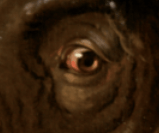
“All animal lovers in Leipzig are informed that a living rhinoceros has arrived, which many people believe to be the Behemoth as described in the book of Job, chapter 40, verse 10. It is worth seeing to all those who come to visit it. It is the first animal of this species which has come to this town; it is about 8 years old, and therefore still a calf, as it will continue to grow for many years, because these animals can reach an age of 100 years. It is almost 5000 pounds in weight, and much larger and heavier than in 1741, when it was brought from Bengal to Holland by Captain Douwemout, only about 3 years old at the time. It was caught in Asia, in the dominions of the Great Mogul, in the region of Asem, which is some 4000 miles distant from here. This wonderful animal is dark-brown, has no hairs just like the elephant, except for some hairs at the end of the tail; it has a horn on the nose, with which it can plough the ground much faster than a farmer with a plough; it can walk fast, and also swims and dives in the water like a duck; the head is pointed in the front, the ears are like those of a donkey, and the eyes are very small compared to the size of the animal, and only allow it to look sideways; the skin looks as if it is covered with shells, which lay a hand breadth over each other, about two inches thick; the feet are short and thick, like those of an elephant, with three hoofs. The animal is an archenemy of the elephant, and when the two species meet, the rhinoceros tries to hit it with its horn under the belly and kill it in that fashion. The animal secretes some potion, which has cured many people from the falling sickness. The animal can be seen from 9 am to 12 noon, and again from 2 pm to 6 pm in the afternoon. Persons of rank can pay according to their desire, while others pay 1 Gulden or 4 Groschen, according to the view. A woodcut can be bought at the same place for 1 Groschen. Also available are large engravings for half a guilder while the small engravings with the Indian cost 2 Groschen. All are advised that the animal will stay only 10 or 12 days in this town.”
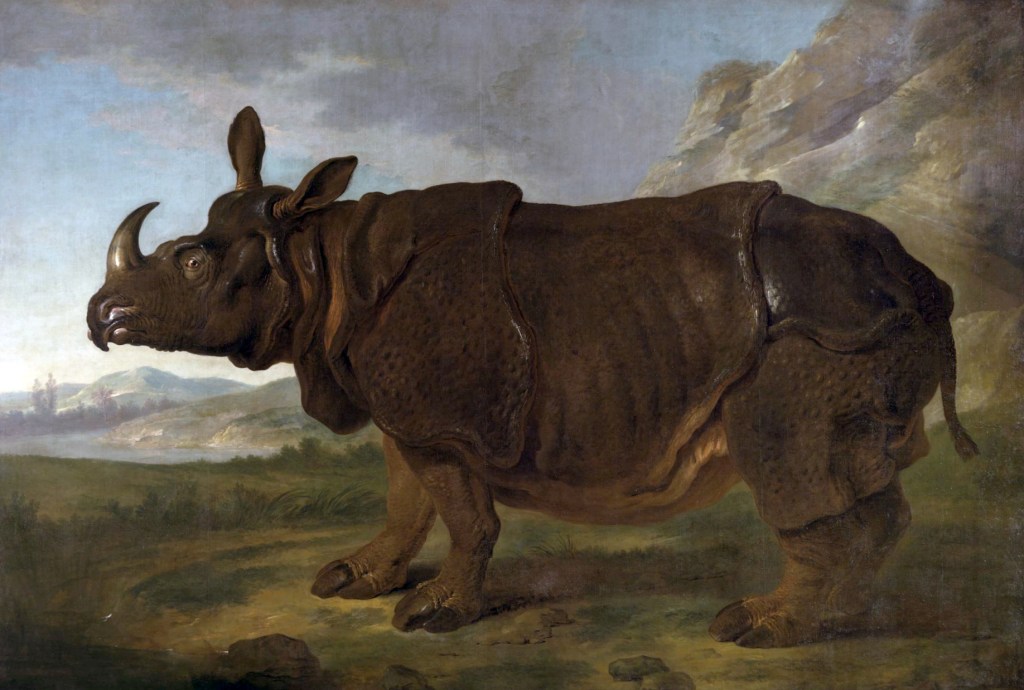
Only eight rhinoceroses reached Europe between 1515 and 1799, all Indian rhinos. The most famous of them is the “Dutch Rhino” also known as “Clara” and as the rhinoceros of Louis the 15th. Orphan Clara was adopted by the director of the Dutch East India Company and somehow transported from Bengal in 1740 to die 18 years later in London, aged about 20. She was being exhibited with entry prices of sixpence and one shilling.
Clara stayed 5 months at the Royal Menagerie in Paris where she created a sensation and first sparked the “Claramania” that was to overtake Europe. She was examined by the naturalist Buffon. Drawings of Clara based on Oudry feature in the first Encyclopedia: L’Encyclopedie of Diderot and D’Alembert.
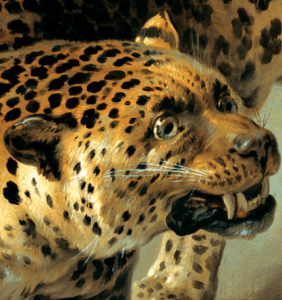
Oudry was a court painter who specialized in hunting scenes: dead rabbits, raw flesh, bloody pheasants hanging from hooks. It is as a portraitist of royal pets that Oudry gained the attention of Louis the 15th and became the natural choice for a life-size portrait of the Royal Menagerie’s rhino. Painter-in-Ordinary of the Royal Hunt was his title.
Oudry was a people pleaser, a favorite of both the Queen and the King, and had his own apartment in the Louvre (!). He was good with dogs and Louis the 15th was nuts about his favorite pooch, Polydor, of whom Oudry would paint fantastic hunting portraits.
His life-size painting of Clara is the painting of someone who has never seen a rhino before. Included in the painting is the surprise at seeing the creature.
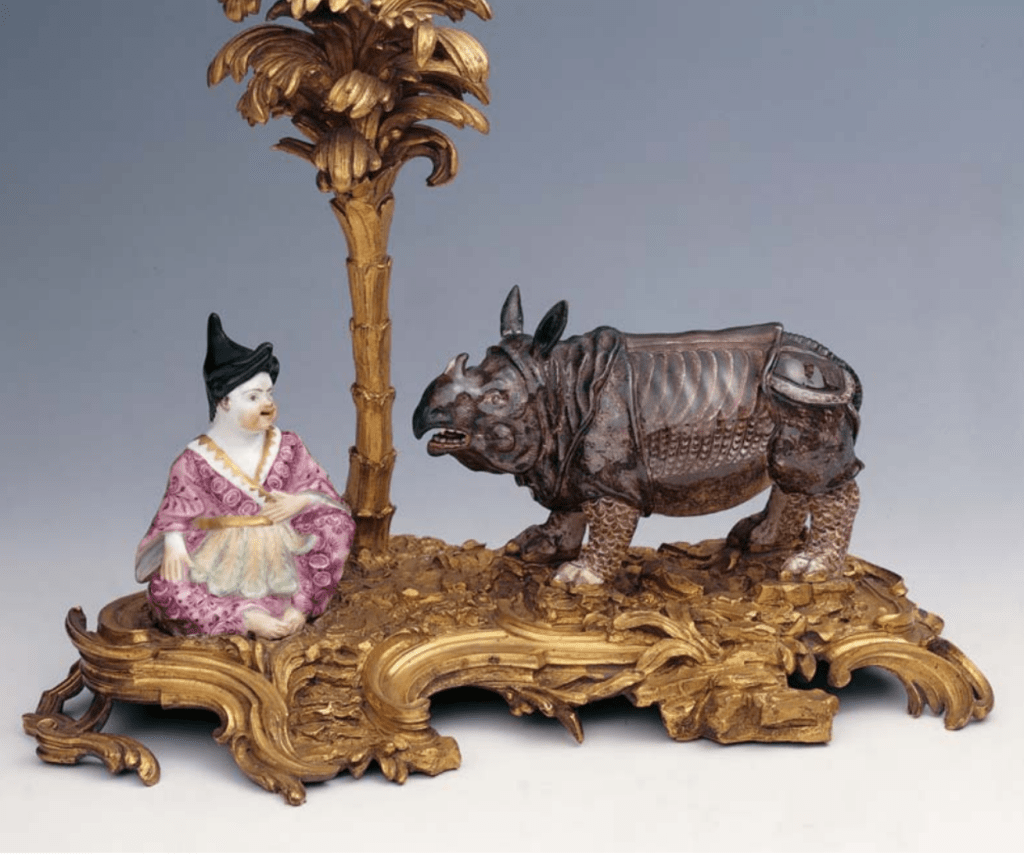
Songs and poems were written about Clara as well as wonderful decorations like this Rhinoceros Mounted with a Chinoiserie Figure. Porcelain and bronze ca.1740. Frankfurt, (Museum für Angewandte Kunst.)
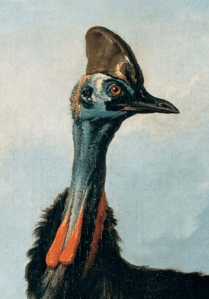
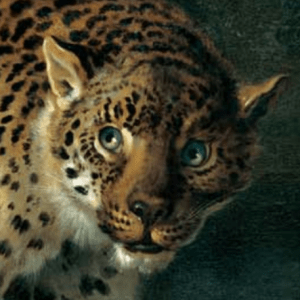
Clara By Jean-Baptiste Oudry – 1. Staatliches Museum Schwerin2. Unknown source, Public Domain, https://commons.wikimedia.org/w/index.php?curid=1030168
 THE INACTIVIST